
OpenQuantum
NTNU · Trondheim
I am part of the OpenQuantum project, where I develop coupled-cluster theory for electronically open systems — molecules and extended systems, such as surfaces, that exchange electrons with their surroundings.
I am a theoretical chemist working on electronic structure theory, in the fields of Relativistic Quantum Chemistry and Open Quantum Systems. My work sits where method development meets implementation: deriving the equations and making them run in production quantum-chemistry codes such as DIRAC and eT.
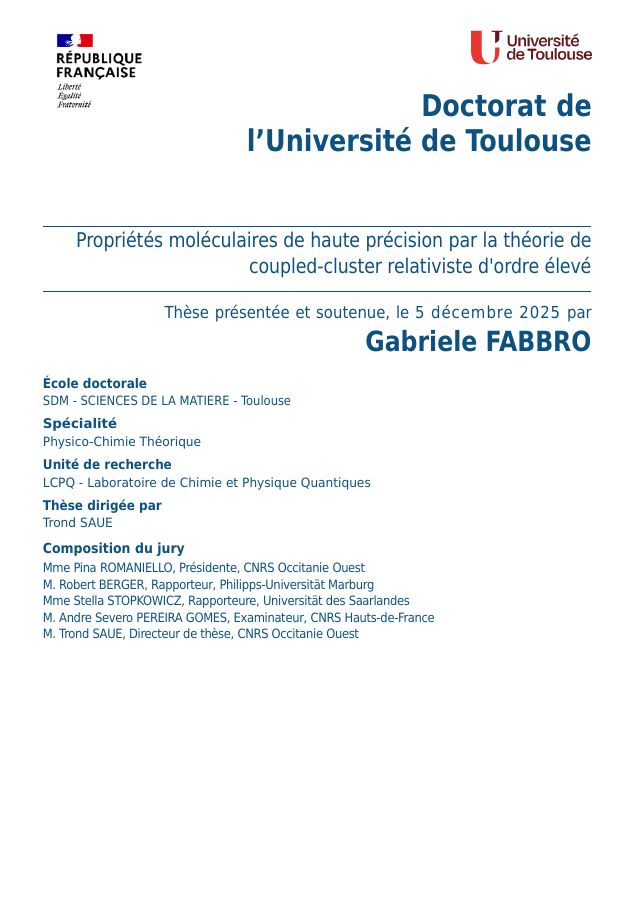
I obtained my PhD in Theoretical Chemistry at the Université de Toulouse with Dr. Trond Saue, working on highly accurate relativistic coupled-cluster methods for molecular properties. I am now a researcher at NTNU in Norway.
NTNU · Trondheim
I am part of the OpenQuantum project, where I develop coupled-cluster theory for electronically open systems — molecules and extended systems, such as surfaces, that exchange electrons with their surroundings.
Extending coupled-cluster theory to molecules and surfaces whose electron number is not fixed.
High-order relativistic coupled cluster (up to CCSDTQ) and its expectation values, for molecules containing heavy elements where relativity cannot be treated as a small correction.
Highly accurate electric field gradients at nuclei, combined with experimental spectroscopy, to extract reliable nuclear quadrupole moments from molecular systems.
During my PhD I was a member of the HAMP-vQED project, focused on highly accurate relativistic coupled-cluster methods.
I developed a diagram-based framework for the automated generation of expectation values at arbitrary excitation rank, built on the tenpi equation generator, and used it to implement expectation values at the CCSDT and CCSDTQ levels in the DIRAC program package. I then extended these expectation values to a massively parallel, multi-node framework based on the distributed-memory Cyclops Tensor Framework, giving access to larger active spaces than single-node implementations.
The main target was the electric field gradient (EFG) at nuclear positions — both its chemical interpretation beyond the Dailey–Townes model and its use for the reliable extraction of nuclear electric quadrupole moments.
arXiv:2610.38873 (2026)
J. Phys. Chem. A 2026, 130, 3187–3196
J. Phys. Chem. A 2025, 129, 6942–6958
J. Phys. Chem. A 2025, 129, 1006–1025
Open Quantum Systems: When molecules exchange electrons with their environment
Theoretical Chemistry seminar, NTNU · Trondheim, NO
Relativistic Effects: A “Gentle” Introduction
TK seminars, NTNU · Trondheim, NO
Highly Accurate Expectation Values using High-Order Relativistic Coupled Cluster Theory
Seminar, NTNU · Trondheim, NO
Highly Accurate Molecular Properties using High-Order Relativistic Coupled Cluster Theory
14th International Conference on Relativistic Effects in Heavy-Element Chemistry and Physics (REHE) · Amersfoort, NL
Molecular Properties through Coupled Cluster Theory
27th DIRAC Working Group Meeting · Odense, DK
Coupled Cluster Method for Molecular Properties
20th ETSF Young Researchers' Meeting · Toulouse, FR
Beyond the Dailey–Townes model: chemical information from the Electric Field Gradient in a Relativistic framework
Seminar, University of Trieste · Trieste, IT
Beyond the Dailey–Townes model: chemical information from the electric field gradient
26th DIRAC Working Group Meeting · Odense, DK
PhD in Theoretical Chemistry
Université de Toulouse, France
Advisor: Dr. Trond Saue
European Master in Theoretical Chemistry and Computational Modelling
Università degli Studi di Trieste, Italy
110/110 cum laude · Advisor: Prof. Mauro Stener
Bachelor's degree in Chemistry
Università degli Studi di Trieste, Italy
110/110 · Advisor: Prof. Daniele Toffoli
Erasmus student Elias Neumann — manuscript: Relativistic effects on the bond length of CuH, AgH, and AuH
Co-organizer, 21st ETSF Young Researchers' Meeting, Trieste
Evaluation committee, M2 TCCM end-of-Master defences, Toulouse